For decades, Rajabas Dholbajhiya settlement in Ward No. 9 of Barahakshetra Municipality, Sunsari, lived under a rising shadow of conflict. At the center of it was land—land that people had cleared, cultivated, and built homes on, but whose ownership lay elsewhere on paper. What began as a quiet tension over “who owns what” slowly grew into a deep, dividing conflict involving 45 households, formal landowners, a local school, and community groups.
The clash was not just legal. It was emotional, historical, and increasingly hostile.
On November 5, 2025, that shadow finally lifted. In a landmark ceremony held in the ward office premises, 29 households received their land ownership certificates (Lalpurja). For many, the moment carried more than legal meaning. It represented decades of sweat, tears, and struggle. As they held their certificates, some eyes filled with tears, while others broke into smiles.
Geeta Nepal, a local resident and one of the ownership certificate recipient, said with visible excitement, “Now this land truly belongs to us. Dialogue has won, and this certificate has given us not just permanent ownership, but a sense of lasting peace.”
Handing over the certificates during the program, the Deputy Mayor and Coordinator of the Judicial Committee, Nanda Kumari Rai, remarked, "When a community chooses the path of dialogue, no solution is impossible. Today is a testament to that belief."
However, this journey to success was by no means an easy one.
The settlement began more than six decades ago when families from different communities migrated into the forested area of Rajabas. They cleared trees, built homes, and turned the land into farmland through years of hard labor. Over time, institutions like the Srijunga Yugsing Nishan Him Bhasha Bhashi Basic School also began using parts of the land.
But later, a harsh reality surfaced. Out of the 29 bighas (19.64 Ha) of land being used and cultivated, 23 bighas and 3 katthas (15.68 Ha) were legally registered under the names of the Malla families residing in Kathmandu. That discovery turned lived reality into legal conflict.
Local resident Krishna Limbu says: "We cleared the forest and turned it into cultivable land. Each of us spent our sweat and hard work to make this land fertile. But it was only much later that we realized the land actually belonged to someone else."
Some community members even recall incidents where people lost their lives to illness while clearing and preparing the land. Because of this, they shared a deep emotional bond with the soil.
One side, the registered landowners, sought to proceed with plotting and formal transfer or sale of the land. The other side, the 45 households who had lived and worked on the land for generations—demanded recognition based on settlement, use, and labor.
From that point, two positions hardened.
By 2015/16 (2072 BS), the situation became more complicated when the Malla families granted power of attorney to initiate land plotting through local representatives Karna Bikram Limbu and Jamuna Timsina. This triggered immediate resistance from settlers and other users of the land, including the school and Sayapatri Club.
Surveying, demarcation, and ownership discussions led to repeated conflicts. Even attempts to allocate portions of land during demarcation failed to satisfy competing claims. Each side saw the other as blocking what they believed was their rightful claim.
Negotiation attempts followed—but broke down repeatedly.
Meetings turned tense. Dialogue gave way to accusations. Over time, trust collapsed completely. Residents recall periods where conversations escalated into verbal abuse, and in some cases even physical altercations. Fear became part of everyday life in the settlement.
By 2022 (2079 BS), the conflict had reached the ward office. But even formal process deepened disagreements rather than resolving them. Accusations intensified, and positions became more rigid.
The case was then referred to the Judicial Committee of Barahakshetra Municipality. Multiple rounds of discussions were held, but no agreement held. The conflict remained stuck—legally complex, socially emotional, and politically sensitive.
Ultimately, the Judicial Committee of Barahakshetra Municipality decided to refer the conflict to the Natural Resource Conflict Transformation Center-Nepal (NRCTC-N), for a multistakeholder conflict transformation process.
When the center induced Spider Web methodology on November 22, 2024 (Mangsir 7, 2081 BS), the situation was already highly polarized.
The process began not with solutions, but with rebuilding communication, dialogue and relationship in a fractured community.
A 13-member “Spider Group” was formed from within the affected community itself. After a three-day capacity-building and leadership handover training, they began facilitating the conflict transformation process through structured engagement. Various stages were carried out step by step, including individual and group meetings, discussions, process proposal preparation, issues identification, exploration of alternatives, and joint meetings.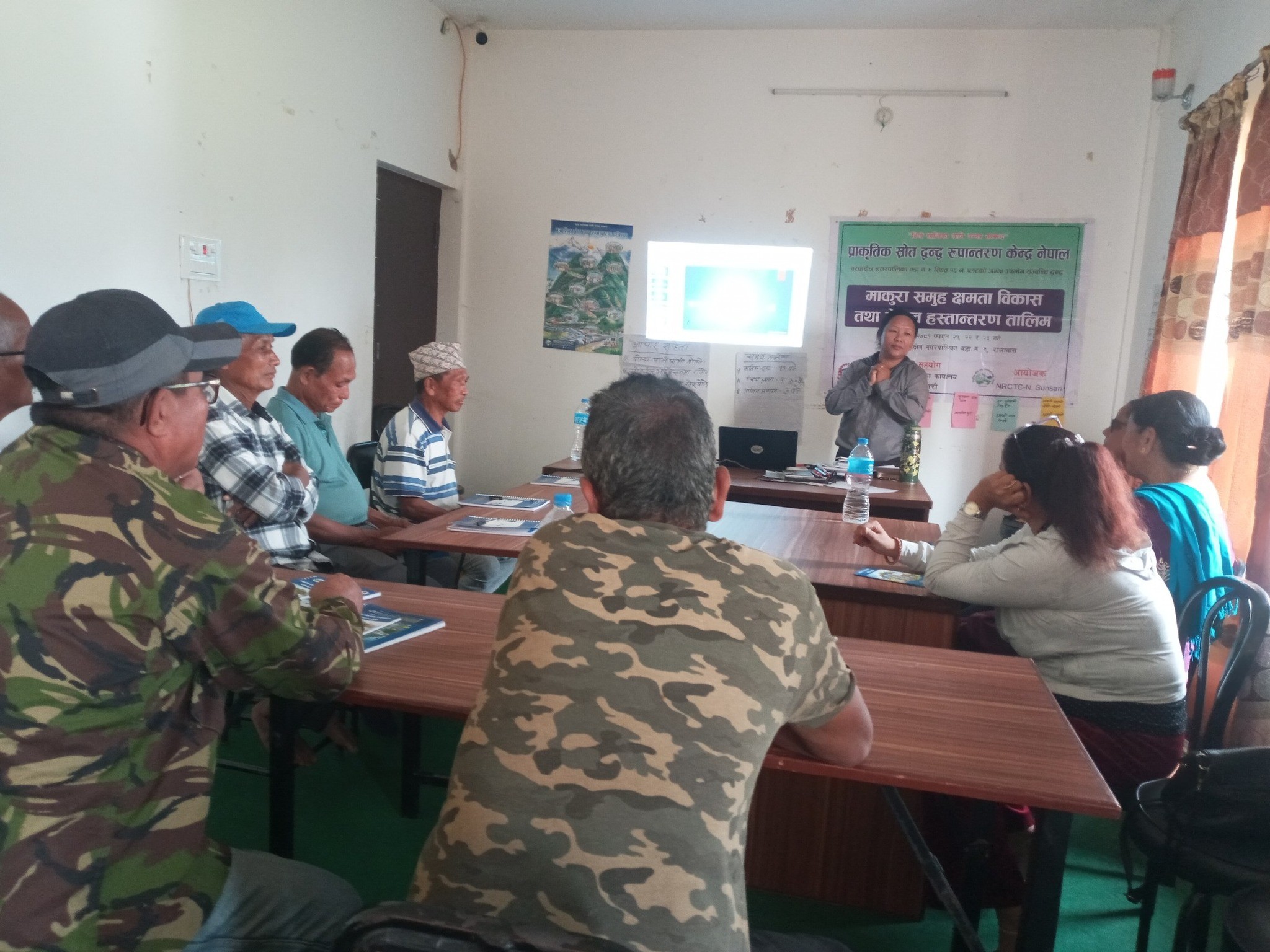
With continuous facilitation from the spider group, a common agreement was finally passed on April 2, 2025 (Chaitra 20, 2081 BS). This practice of seeking a solution through mutual dialogue and understanding—without resorting to courts or the use of force—became a novel experience for the community.
The decision acknowledged both sides of the conflict: part of the land would be legally transferred to long-term users, while the remaining portion would remain under the registered owners. It was a win for both sides that ended years of deadlock.
Implementation followed.
Out of 45 households, 29 have already received land ownership certificates in their names. The process of transferring land to the remaining families is also progressing step by step.
For beneficiaries, the transformation closed a painful chapter. For landowners, it ended years of uncertainty and stalled property use. For institutions involved, it restored order where there had been prolonged gridlock.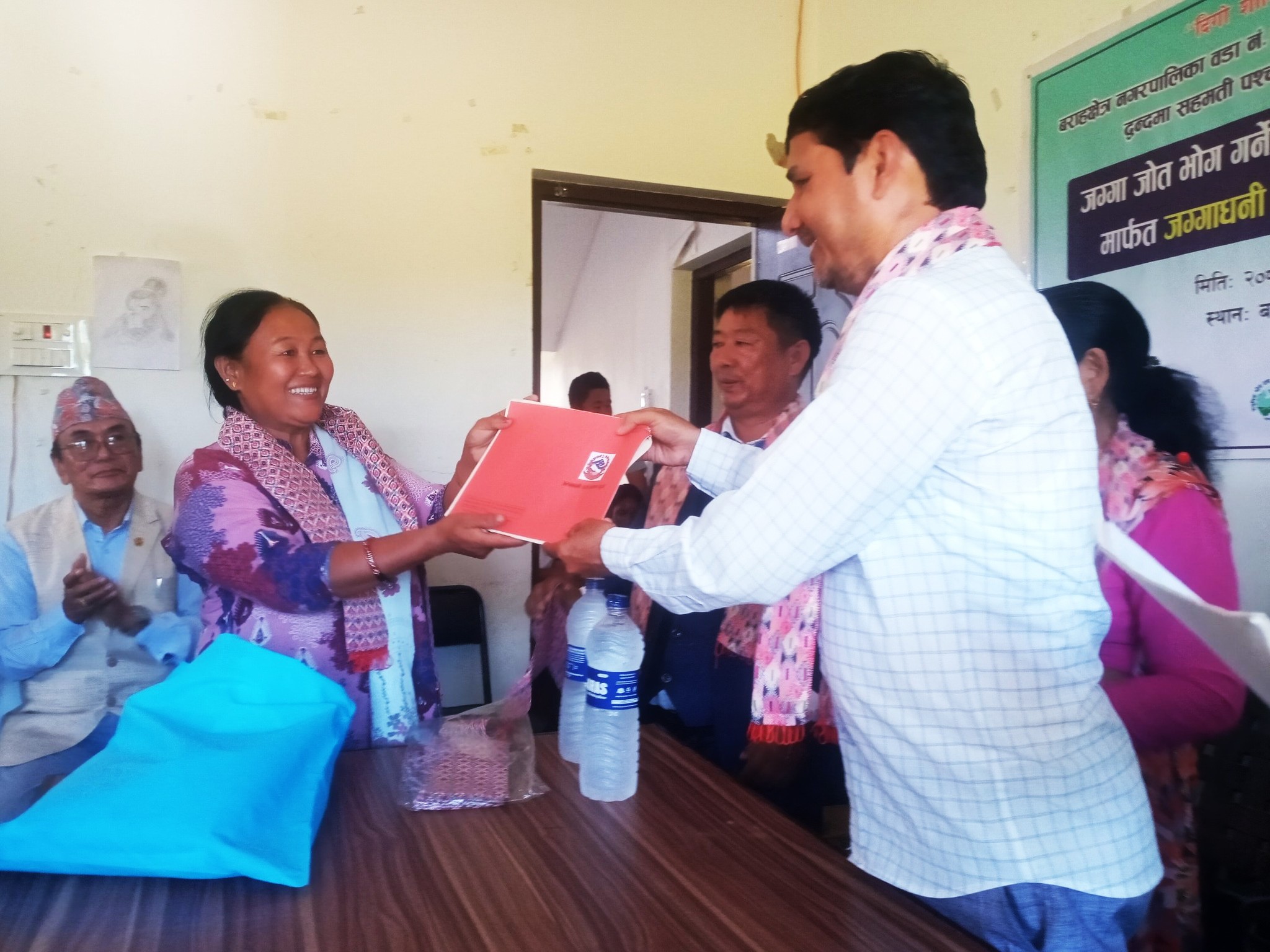
Syauli Darji, one of the beneficiaries who received a land ownership certificate, recalls the past and says, “Some of us were living in houses built on just five dhur (84.65m2) of land. Many of us were in very weak economic conditions. Today, receiving land ranging from 10 dhur ( 169.30m2 to 4 katthas (1354.52m2 ) is a huge achievement for us. We are very happy.”
The landowner side is also satisfied with the agreement. They say, “If this organization had not been involved, we would have had to go through the courts. In court, there would have been winners and losers, but relationships would have been damaged. It would also have cost money. Now the issue has been transformed in a way that benefits everyone. The process for the remaining families to receive land ownership certificates is also moving forward. An environment has been created where everyone can be guided toward a smooth transformation.”
But the most significant change was not administrative, it was relational.
A settlement once defined by suspicion, threats, and broken trust has begun to stabilize. Conversations have restarted between groups that had not spoken for years. The atmosphere of fear has eased, replaced by cautious cooperation. The feeling of “mine and yours” has been replaced by a sense of “ours.”
“NRCTC-N and spiders worked like a blessing for us. We had already lost hope. Seeing the transformation today, we feel that dialogue can truly perform miracles.” -Narayan (Taramani) Nepal, Local resident.
The transformation that took place in Rajabas of Barahakshetra is not just a story of transferring land ownership. It is a powerful example of how a community-centered conflict transformation process can turn a complex conflict into lasting peace.
What made this transformation possible was not force or court judgment, but a structured community process that allowed the conflict itself to be unpacked, understood, and gradually re-negotiated.
The Rajabas conflict now stands as a clear example of how deeply rooted land conflicts—when left unmanaged—can escalate into prolonged social breakdown, and how they can also be redirected toward transformation when dialogue is systematically rebuilt from within the community itself.
The Natural Resource Conflict Transformation Center–Nepal has been working to transform multistakeholder conflicts related to water, forest, and land through the spider-web approach. The experience of Barahakshetra stands as a successful and inspiring example of this initiative.